Monday, 18 June 2012

Project 23 Black

Project 22 Black

"To be a woman in Western Society is to be a member, arguably of an oppressed majority (even though we are in the age of equality) To be black in this society is to be a different form of ' the other'.

We are move away from the concept of 'the other' - looking only at gender and sexuality (project 20-22) into the subject of racial issues

Task to read Fact of Blackness by Franz Fanon (course reader)

Fanon (1925-1961) was a post colonial writer born in the French colony of Martinique.  After the 2nd world war he stayed in France to begin his academic career.  When he was working in Algeria the war for Independence broke out and he aligned himself to the Independence movement and became Ambassador for Ghana in the Provisional Government.  He died in the year of the publication of his book The Wretched Earth.

Fanon was writing from the view of a black colonial (a second class citizen) in his own country - I think this would make it more difficult as the world would make it harder for the black citizen as there is a split in the self as you become what are are perceived to be as a lower citizen  The issues that Fanon explored that applied to the visual studies, many artists be they Afro-Caribbean, African or Asian decent that work within Britain (the country of their birth).

Chris Ofili was born in Manchester and caused a sensation in the International Art World by being the first black artist to win the Turner Prize.

Afro Love and Unity 2002


This is painted about old fashioned ideas of paradise Red, black and green represent African nationalism and black unity (black man and woman) there is a connection with Marcus Garvey in the 1920s the Black Panthers and Militant political movements of the 1960 and 70s this could be a pointer back to those days and to see what reaction there is when the colours and points of view are bought back into the modern day.

Lubaina Himids  Jelly Mould Pavilions 2009-20


Lubaina Himids work investigates and looks a historical representations of the people of African diaspora and highlights the importance of their cultural contribution to the contemporary landscape.  She was one of the pioneers of the Black Art movement in the 1980s.  These hand painted Victorian jelly  moulds were done to celebrate the ongoing contribution of the Black community to the City of Liverpool.  These were models of monuments which will never be built.  The ceramic forms are covered in bright coloured text and portraits.  Their purpose is to encourage visitors to ask questions about the city's history how we can celebrate and commemorate the Black community or whether we already do this.

Lubaina  chose Victoria jelly moulds as they symbolise the African link to the sugar industry that once enslaved Africans.


Alvin Kofi


New Embrace (poem)

Alvin Kofi born in London of African and West Indian heritage - has been an artists for over 20 years - his first love is drawing.  On his return from Africa in 1998 he quickly established a reputation having produced the first Black Print Collection distributed in the U K.  Subject and themes have varied over the years but the tradition of Africa has been constant throughout.  In 2003 he started the arts collection 'Black Arts Forus' where he got together 18 black artists to explore their work and experiences.

In Care


 'Lost and NOT FROGOTTEN' is his latest collection which represents studies in life which shows that our ancient past is ever present in poor expression of ourselves.


At Peace (poem)


Wishum Gregory


Gregory takes images and artwork to create a unique montage that captures the essence of each particular theme.  I have chosen King the Life-the Dream- the legacy which honours the legacy of Dr Martin Luther King and  his fight of equality  of all people regardless of colour or creed.  This latest poster also shows the new national memorial and monument in Washington D C opened to the public in 2011.

Other black artists I have found are Sterling Brown, Elizabeth Callett, Lennie Lee, Frank Auerbach, Sonia Boyce, Frank Bowling to name a few.

Also I thought it might also be worth mentioning a couple of books on the subject
Alice Walker (Colour Purple) and Alex Hailey (Roots and also Queen). Both of which I have read with great interest.

Wednesday, 13 June 2012

Project 22 two fried eggs and a kebab

Project 22 Two fried eggs and a kebab

To consider the work of Sarah Lucas and note any references to the theories that I have looked at so far.

Sarah Lucas was one of the 'Young British Artists' that arrived on the art scene in the 1990's her work mainly consists of self-portraits and uses a variety of mediums to achieve this as she shows life as a woman in the modern world.
Task 1

Two fried eggs and a kebab 1992

 Here Sarah uses foods as a sexual innuendo - a woman is transformed in to a commodity to be possessed and consumed  part of her being a piece of meat.  I think maybe this could link up with Project 21 (images of women, she transform a gaze in to objects.

Task 2

Au Natural 1994

 This work deconstructs the sexual act - genitals are replaced with commodities the soiled double mattress leaning against the wall- an erect cucumber with two oranges at its base - (the man) a bucket and two ripe melons (the female).  This could tie up with the project on Signs and Symbols.

Task 3


Self Portrait with two fried eggs 1996


 In this art work the eggs replace the breasts on the actual female form- to all outward appearances this could be a male with the short hair, T shirt, ripped jeans and man like shoes which supports the irony of the picture.  I wonder if could be aligned with Project 18 the mirror phase?  She does not appear at all feminine in this image.

Task 4

 Eating a Banana  1990

This I believe has great connotations which comment on the castration anxiety in Project 21.  Lucas gazes definitely at the spectator challenging the male gaze.  She avoids the phallic symbols by biting the banana which directly threatens castration.  I think she could be challenging Berger's argument in Project 21.

Monday, 11 June 2012

project 21 images of woman


Project 21  Images of Women

John Berger - ways of seeing Chapter 2 and 3

Berger argues that the tradition of the nude in paintings is almost exclusively that of the female form which is then presented to the male viewer.  The female nude is then possessed not only by the male collector but almost the male viewer.  Looking at women is defined by their appearance and thus the male gaze operates.

Task 1  We are asked using magazines and newspapers as a source to construct a visual study essay showing the visualisation of woman today


The above six pictures of the female form from a woman's perspective


the above 6 pictures of females from a man's perspective

In the first six pictures it is interesting to note that they reflect Lacan's theory of the mirror phase these are what we would like to achieve in looks ourselves but have to realise that a most of these are air brushed etc so have the feeling of being inadequate.

In the second six we see the interpretation that the male enjoys looking at and would like to find someone in their image   (Berger's argument)  The social presence of a man is to have the promise of power  which he embodies this maybe moral, physical, social sexual etc i.e to have power over the woman.   Where as
the woman expresses her own a attitude of herself by gestures, voice, opinions, clothes taste etc. From her earliest childhood woman have been taught to survey herself at all times.  Men look at women where as women watch themselves being looked at.  

The Future Unvielded 1912 oil on canvas by Suzanna Valadon   Geneva

Here Suzanna Valadon does not adopt the typical masculine approach in representing a naked woman.  She has placed the figure in a private area, (traditionally a woman's place was within the domestic sphere).  The woman is not alone nor placed as an object of desire for a man's pleasure.  She reclines on a sofa her naked body fully exposed she is relax and in a confident pose she appears to be completely indifferent to her nakedness as though it is quite a natural state, and does not offer her body as a exhibit for the male spectator, her eyes are looking down at the fortune teller as she deals the cards she is fully absorbed in her own thoughts disinterested in pleasurable experiences for a male audience.
Valadon's painting could be seen as a statement that this woman is not to be regarded as an object of male sexual desire and defies male objectification of the female subject.  


                                           Le Sommeil (Sleep or The Sleepers) 1866 oil on canvas Paris

This is an erotic painting on canvas- which depicts lesbianism.  It was commissioned by a Turkish diplomat and art collector who lived in Paris.  This painting was not permitted to be shown publicly (due to the nature of the subject) until 1988 when is was exhibited by a picture dealer. In 1872 it became a subject of a police report!  The painting shows two naked women lying asleep on a bed entwined in an embrace as couples do.  The setting is a bedroom with various textiles and ornamental furnishings - in the background there is a dark blue velvet curtain which ties in with the subject matter and in the right corner a table with a decorative flower vase.  In the foreground is a small wooden table with three items, a small vessel a transparent vase and a cup there is nothing else in the painting to overshadow the main image - Courbet worked curves between the women a broken peal necklace and hairpin scattered on the bed is reference to the nature of their previous activity.  These painting has been interpreted as a realist painting detailing the bodies without glossing over their imperfections. 


The Tepidarium by Sir Lawrence Alma-Tadema 1881 oil on panel  Liverpool

The word Tepidarium was a warm Roman Bath.  This picture carries a strong erotic charge rare for a Victorian painting of a nude.  The woman reclines in a pose of exhaustion on a marble couch beside the bath  Her face is flushed perhaps because she has just emerged from the hot bath.  In one hand is a strategically placed ostrich feather fan, barely concealing her genitals.  She holds the fan as if it about to drop from her grasp.  In her other hand she toys with a strigil ( a bronze implement used to scape oil or sweat off the body. This implement combines archaeological authenticity with a explicitly phallic shape, and the general air of sensuality is enhanced by the contract of the fur rug the silken cushions and the naked body.

The above three paintings  are those which would possibly hold more interest to the male viewer


Girl with white dog 1950 Lucian Freud  Tate  oil on canvas


This painting  is of Freud's first wife when pregnant she looks contented and relaxed sitting by a window with her faithful white dog. The drapes behind her are muted also the cover on the bed gives a contract to the plain coloured dressing gown.  One would imagine that she and her dog are both looking at the artist.


  Reclining nude 1942 oil on canvas  Victor Pasmore     Tate

Pasmore produced a series of small and tender portraits and nude studies of his wife,Wendy.  This one presents her in a quiet and intimate manner with the parted curtains adding to the personal time alone. Notice how the light shines across her body and the bed.


Morning 1926  Dod Protor oil on canvas  Tate

The was voted Picture of the year at the R.A. summer exhibition in1927 its popularity has been displayed in New York and a tour of Britain in 1927-1929.  It shows a young girl reclining on her bed in the morning almost awake.  The light from the window gives a powerful sense of volume and peace also the muted colours make it a joy to look at.


These three paintings above I think would be more interesting to the female eye. 

Project 20 Gendering the gaze

 Project 20 Gendering the gaze


How does one describe the Graze?  a) a practise of looking b) to look at something that interests you steadily and for a long time to study as a whole and in sections.  Laura Mulvey illustrates this in the conventions of the cinema though its context you are not able to study each part for long as you could with static i.e. photo's, paintings books etc.  (only by watching a film many times could you partly achieve this).  Mulvey takes a feminist stance (many criticise her views).  In film making it is assumed by some that the audience will be male so will enjoy watching beautiful women or looking for the perfect male which they would like to portray.  This not only applies to the movies - art- magazines etc assume that the gaze will be a male.  Mind you in some context the same could be applied to the female observer who may feel threatened by a beautiful woman but enjoy seeing a handsome man.

The Film Vertigo   by Alfred Hitchcock

This film is a psychological thriller about a retired police detective suffering from acrophobia who is hired as a private investigator to follow the wife of a acquaintance to uncover the mystery of her peculiar behaviour.

Vertigo was based on a French novel D'Entre les Morts by Pierre Bolleru and Thomas Narcejac.  The film is an example of turning pulp fiction into art.  Scottie (played by James Stewart) fulls in love with the woman he is watching.  When Judy is reconstructed as Madeline and becomes a fetish, she is eventually punished for her treatment of Scottie.  The male gaze is shown as natural in the film,  Self-identification with the ideal ego is confirmed by the way the camera is used though the eyes of the male gaze thus implicating Scottie's obsession.  The audience members are also implicated in Scottie's obsession through the point of view.


Task 2    R and B music   most  R and B videos     Some of them almost celebrate the male gaze.  It is interesting to note that in some Hip Hop video's the female body is portrayed in close up thus causing fertilisation.


Task 3   Manet Olympia  an annotation

The image is geared towards the male viewer which should suggest the physical possession of the female nude.  She looks out from the painting as if her lover had just entered the room after sending in a bunch of flowers with her maid (who is almost invisible apart from her clothes and the white paper around the coloured flowers,  Notice the maid's eyes ( you can just see them!)  they appear to be cast down, she is denied the power of the gaze and is subservient to her mistress

Manet took a famous Old Master painting in this  case Titian's Venus of Urbino and created his own modern variation on it.  When first shown to the public people (mostly woman) found it offencive for two reasons  she was clearly a courtesan and was not languorous and inviting, but cool and confident in her nakedness to stare down at her visitor i.e. the spectator whose entrance caused the cat (by her feet ) to arch its back.  Erotic details are the ribbon around her neck the flower in her hair her hand placed on her naked body, slipper dangling from her foot and the flower in her hair. 


Thursday, 7 June 2012

project 19, looking, observation or surveillance

Project 19 looking, observation or surveillance


definition of Panopticism

(Panoptic)  including everything visible in one view a panoptic aerial view

Read Panopticism charter 5 by Michel Foucault (Discipline and Punish 1977)  this is about the criminal justice system and the power it has and was influential in post-structuralist and postmodern art theory which has implications for the visual culture.

i.e.  from the on line article by Shannon O'Neil, (What does the panoptic schema have to do with art)?

There are one or two applications for this concept in the information  we receive in this digital age (issues of individual rights in society to display and or manipulation of images to how museums etc.are set up.  We now have reality T.V. web cams, digital cameras, moving adverts, everywhere you go, train stations, garages.  Traffic surveillance, being watched in shops and even waking through the streets are all threats to our privacy even the telephone is not except as you get calls trying to sell business to you.  Since the advent of films, T.V. photography and other media the voyeur to the third party within the realms of the sear and the seen.  (Leigh O Neil s).

For Foucault, panopticism becomes a metaphor, according to him modern societies are structured around relationships between power and knowledge.  Power is structured to produce people who will actively participant in self-regulatory behaviour.  The systems that are in place encourage us to self-regulate and to do so without any threats of punishment which in turn makes us behave and conform, it is the structure of surveillance itself which makes us conform whether it is active or not.

Video artists and the panopticism

Lindsey Seers   To use oneself as the subject could be seen as a representation of the power dynamic central to modern society I wonder if this could be aligned with Freud's notion of the super-ego or perhaps the artist in becoming the subject of his or her own artwork has a much greater leaning towards Lucan's concept of the mirror phase.


Task 2    6 images 2 of which are a result of looking, 2 of  observing and 2 of surveillance


Surveillance Art

1)   Camille Utterback -   created an installation in 2007 called 'Abundance' using the domed city hall of San Jose, California as her interactive canvas.  These includes a large surveillance camera focused on pedestrians and an abstract art animation projected onto the city hall building - All movements within the field of the camera are translated onto the abstract shapes that appear in the projection as the pedestrians etc. moves the corresponding shape moves with other shapes in the projection.  Utterback states that these movements become part of a collective visual record and transform the building into a playful and dynamic canvas.


2)  Andy Warhol's movie 'Outer and Inner Space'  - introduced the performance art possibilities of high tech surveillance to the modern world in this case the actress Edie Sedgwick- On the left Sedgwick video image in full profile gazes to the right looking up as if she were talking to someone standing above her.  On the right we have Sedgwick sitting in a three quarter profile facing left taking to someone sitting off screen to the left of Warhol's movie camera which creates the illusion that we are watching Sedgwick in conversation with herself.


Looking


1)  Dorothea Lange   Migrant Mother (or Madonna of the Depression)    Here Lange photographed a tired anxious but stalwart  mother with three of her children in a migrant working camp.  We see the anguish in the her eyes of trying to support her children and keep them together as a family.


2)  James Stewart  -Rear Window Alfred Hitchcock film 1954  a film about looking.  Scopohilia being the theme.  The most unusual and intimate journey into human emotions.  Seeing is not always believing.  It is based on a wheelchair bound photographer who spies on his neighbours from his apartment window and is convinced one of them has committed a murder.  Though his rear window and with his powerful camera he (James Stewart) watched the great city tell on itself, expose its cheating ways- and murder!


Observation


1)   E Muybridge   Horse Photographs

This was one of the earliest technological responses to the problem of static, artistic representation.  He used high speed stop motion photography to capture a horses motion.  Which proved that the horse has all four feet in the air during some parts of its stride.  These shots settled an old argument and start a new medium and industry.


2)  Helen Levitt   Her photographs were not intended to tell a story or document it, she worked in poor neighbourhoods because there were people there and a street life that was rich sociable and visually interesting  the one I have chosen  shows urban children playing and posing for the camera in the streets you can feel the raw lifestyle and the self-embodied nature of the people who may be poor but seem to be happy with their lot.


Tuesday, 8 May 2012

Project 18 The Mirror Phase

Project 18 The Mirror Phase

Jacques Lacan first delivered  this paper as a talk in 1949, two years prior to the beginning of the seminars when he developed the thought that we now identify with him (The Mirror Phase as formative of the function of the I).  Lacan argues that infants acquire their 1st sense of self-identity (the formation of an ego) though the experience of looking in a mirror and relating to their image this experience captures the stage in the child's development when they anticipate a mastery of the body that they lack in reality (in other words an infant is not aware of the movement it makes until they see their reflection)?  The body though the mirror image becomes a whole.  When Lacan refers to " The body of Gestalt" (1949) he is referring to the fact that we are presented with an image that we identify with but are unsure which is figure and which is ground.  Until we start to move and watch ourselves do we see that the actual self is, less than perfect and even accentuates the difference between who we are and what we think we are. ( We think and maybe at times feel 21 then see our refection are realise that it is not so).

Examples of Surrealist Work that might echo the Mirror phase

Rene Magritte (1933)    The Human Condition   Oil on Canvas  Washington D C National Gallery of Art


Here we see a pleasant landscape framed by a window.  In front of which is a painting on an easel that "completes" the very landscape it blocks from view.  The problem of the real space versus the spatial illusion is as old as painting itself, but it is imaginatively treated in this picture within a picture.  Magritte's play on illusion implies that the painting is less real than the landscape when in fact both are painted fictions.  The tree, as the artist explained (somewhat confusing in the view of the illusory nature of the "real" landscape as he define it) exists for the spectating "both inside the room in the painting and outside in the real world" i.e. we see is as being outside ourselves even though it is only a mental representation of it that we experience inside ourselves.

Magritte drew freely on the Freudian repertoire of sexual anxiety, occasionally creating works that foil a male heterosexual viewers erotic interest.


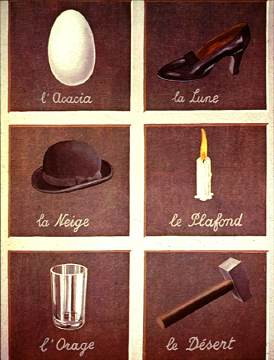
My second examples is also by Rene Magritte called "The Interpretation of Dreams  1930 Munich Germany  Oil on canvas


We are confronted with 6 images of familiar objects together with verbal labels - (which are familiar in the language - learning context) suggested by the blackboard like background.  But we soon realise that the words do not match the images under which they appear.  If we try to rearrange them we find that the words do not correspond to any of the images.  In order to be able to operate with symbols it is necessary to 1st be able to distinguish between the sign and the object it signifies  (Leach 1970 43).  Jerome Bruner observed that pre-school children thought and the object of thought seemed to be the same thing, but once at school they learn to separate word and thing (Bruner 1966)  The child soon discovers the apparently magical power of words for referring to things in there absence.


Personal Values   1952   Rene Magritte  1952  San Francisco U.S.A.   Oil on canvas   


In the painting Personal Values the objects of vanity suddenly take on great importance.  The painting is based on a simple but very effective visual trick, objects from daily life are blown up to a monumental scale, and then placed back into a personal setting where they completely dominate and become shocking.  Magritte presents the room with these familiar things but brings  human proportions to the props of everyday life creating a sense of disorientation and incongruity (the inside and outside are inverted) by his rendering of a sky scape on the interior walls of the room.  The familiar becomes the unfamiliar, the normal strange.  Magritte creates a paradoxical world that is in his words " defiance of common sense"


Salvador Dali   The Persistence of Memory  1931 Oil on Canvas   New York


The beach and rocky terrain shown at the top of the painting were likely influenced by Dali's childhood experiences hence the single apparently dead olive tree underlines the dreamlike and desolate character of this landscape.  (Traditionally the olive branch is a symbol of peace, purification and plenty).  The foreground represents a timeless and nameless inner space.  The watch could allude to time passing memory and decay.  The softness of the instruments for measuring time however renders them unreliable.  The limp head in the centre is thought to be Dali's own face, its shape deriving from a large standing rock near the Coast of Cadaques,  with the long eyelashes and tongue like protuberance which could heighten the erotic feel of this creature- the insects are associated with decay - together with a fly- could the meaning be an experience of seeing a dead animal being eaten.


Two examples of contemporary media - making use of Jacques Lacan's idea of Mirror Phase.    

In advertising we are invited to project ourselves in to the picture or subject thus becoming the perfect model for the subject advertised.


The film  Curse of the Cat People -This  has Amy the young daughter of Oliver and Alice Reed as a very imaginative child who has trouble differentiating fantasy from reality, has no friends of her own age so makes an imaginary friend through her father's 1st wife at the same time she befriends an ageing reclusive actress who is alienated from her own daughter.


The Per Capital Principle   poster by Morgan Slade and Alex Gross.


A film director - who directs actors and film crew alike, control artistic and dramatic aspects.

The gaze is a psychoanalytical term used by Jacques Lacon it describes the relationship of the subject with the desire to look and the awareness that one can be viewed.  The love story, Titanic (1997) a fictional account of the tragic sinking of RMS Titanic (director James Cameron), involoved a fictional love story of Jack ( who dreams of a new life in Amercia) and Rose (the daughter of a once rich family who is being forced to marry into a rich family) This is played out along side the traumatic sinking of the Titanic and the loss of so many lives.  Their love story sustains the viewers enjoyment.


Sunday, 1 April 2012

Project 17 Freud, Oedipus and castration

Project 17 Freud, Oedipus and castration

When Freud was around in the early 20th century the male was considered the number one in society, women being the weaker sex, there to do the biding of the male- thus Freud suggests that in the 1st stages of development awareness the child is attracted to the opposite sex and senses rivalry with the same sex as themselves. (he called it the Oedipus complex) he believed that this complex is a universal phenomenon, from our evolutionary make up and is responsible for our guilt complex in the matter.

The dissolution of the Oedipal Complex (Freud 1977) pinpoints which this repressive structure forms and also discusses the causes for its creation.  He (Freud) suggests that the male child wishes to replace his father in the family structure - he identifies the paternal figure as authority therefore by extension have relations with his mother, at the same time being fascinated by his penis he betrays the fact by playing with it frequently (Freud, Oedipus 316)  This met with disapproval by authoritative figures, women and men alike.
The complex itself then is how to replace either the mother or the father without the loss of the penis through castration.

Freud suggests 2 outcomes=   the child replaces the father and has intercourse with the mother or he might want to take the place of the mother and beloved by the father.  (highly unlikely!)

He, Freud theories that adult subjectivity is determined by experiences in childhood and that any experience that differs from the Freudian norm are bound to have a very important bearing on the development of the individual.

Edward Munch   Ashes    This depicts the end of a love affair with the man in despair and the woman indifferent.  The title Ashes refers to the burned out log that runs along the pictures edge  (burned out love) or the death of love.

Munch Norwegian B.1863 D.1944 was tortured by sickness ,death, insanity, rejection, unhappy love affairs and guilt (a text book case for Freud).


In Ashes the feelings of death and despair are shown the work illustrates at least 3 examples of head trauma imprint and the need to support the battered head.  The less obvious being the rock pressing the top of the scull in the right lower corner of the painting.  Other rocks that symbolise skulls of death can be seen just behind the waist of the woman.  The tree- the forest is dark and frighting the decaying tree on the left and the bottom are both symbolic of death.  The body remembers early trauma and the hands would try and attempt to comfort the area that had been effected by the traumatic trauma although the person would not be aware of the previous trauma.  The woman holds her head in sorrow.


A quote from Munch -" for as long as I can remember I have suffered from a deep feeling of anxiety which I have tried to express in my art without anxiety and illness I should been like a ship without a rudder".


Castration in seaside postcards  (humorous variety)

(Small history of the saucy seaside postcard:-  they became wide spread in the 1930s at the peak of their popularity the sale of these reached a massive 16 million a year. They were often bawdy in nature making use of innuendo and double ententes and traditionally featured stereotypically characters such as vicars, large ladies and small put upon men mostly husbands!  Donald McGill was well known as the king of saucy seaside postcards he designed and produced over 12,000 seaside themed cards between 1904-1962.  This then moved forward in the film and television industry with the likes of the Carry on films,  Benny Hill, George and Mildred  etc.


In this postcard the speech in the bubble reinforces the image of the man being the submissive partner  in the relationship who has to seek the advise of his wife on the possibility of help from a doctor concerning his lack of sexual desire - which also reinforces the relationship by showing the domination of the woman (who humiliates him by the response that he is beyond help).  This size relationship can be revised in the same card by the man being  muscular and overpowering against the petite female ( the artist is then turning the cultural relationship of men and woman on his head!!  Only exaggerating the difference would the possibility of such behaviour as depicted on the postcard drawing would be acceptable.


On the postcard above  although the woman is large she has a number of children around her together with the newspaper head line and the (Lumme! - I must warn Bert!) suggests that as mentioned above the man is the dormant partner in this relationship. ( Or is he)!!


We now move to the cinema posters with the provocative female (the high heeled shoes, black stocking,suspenders, open top nurses uniform, long blonde hair, long legs sitting on a stool holding a newspaper with a suggestive headline.  The background comprises of a Large letter X with more suggestive pictures behind.  The colours of blue, black and white are bought forward in to the main theme of the girl the stool the blue under her foot and the orange at the bottom of the poster.  This could be construed as a open invitation.