Monday, 11 June 2012

Project 20 Gendering the gaze

 Project 20 Gendering the gaze


How does one describe the Graze?  a) a practise of looking b) to look at something that interests you steadily and for a long time to study as a whole and in sections.  Laura Mulvey illustrates this in the conventions of the cinema though its context you are not able to study each part for long as you could with static i.e. photo's, paintings books etc.  (only by watching a film many times could you partly achieve this).  Mulvey takes a feminist stance (many criticise her views).  In film making it is assumed by some that the audience will be male so will enjoy watching beautiful women or looking for the perfect male which they would like to portray.  This not only applies to the movies - art- magazines etc assume that the gaze will be a male.  Mind you in some context the same could be applied to the female observer who may feel threatened by a beautiful woman but enjoy seeing a handsome man.

The Film Vertigo   by Alfred Hitchcock

This film is a psychological thriller about a retired police detective suffering from acrophobia who is hired as a private investigator to follow the wife of a acquaintance to uncover the mystery of her peculiar behaviour.

Vertigo was based on a French novel D'Entre les Morts by Pierre Bolleru and Thomas Narcejac.  The film is an example of turning pulp fiction into art.  Scottie (played by James Stewart) fulls in love with the woman he is watching.  When Judy is reconstructed as Madeline and becomes a fetish, she is eventually punished for her treatment of Scottie.  The male gaze is shown as natural in the film,  Self-identification with the ideal ego is confirmed by the way the camera is used though the eyes of the male gaze thus implicating Scottie's obsession.  The audience members are also implicated in Scottie's obsession through the point of view.


Task 2    R and B music   most  R and B videos     Some of them almost celebrate the male gaze.  It is interesting to note that in some Hip Hop video's the female body is portrayed in close up thus causing fertilisation.


Task 3   Manet Olympia  an annotation

The image is geared towards the male viewer which should suggest the physical possession of the female nude.  She looks out from the painting as if her lover had just entered the room after sending in a bunch of flowers with her maid (who is almost invisible apart from her clothes and the white paper around the coloured flowers,  Notice the maid's eyes ( you can just see them!)  they appear to be cast down, she is denied the power of the gaze and is subservient to her mistress

Manet took a famous Old Master painting in this  case Titian's Venus of Urbino and created his own modern variation on it.  When first shown to the public people (mostly woman) found it offencive for two reasons  she was clearly a courtesan and was not languorous and inviting, but cool and confident in her nakedness to stare down at her visitor i.e. the spectator whose entrance caused the cat (by her feet ) to arch its back.  Erotic details are the ribbon around her neck the flower in her hair her hand placed on her naked body, slipper dangling from her foot and the flower in her hair. 


Thursday, 7 June 2012

project 19, looking, observation or surveillance

Project 19 looking, observation or surveillance


definition of Panopticism

(Panoptic)  including everything visible in one view a panoptic aerial view

Read Panopticism charter 5 by Michel Foucault (Discipline and Punish 1977)  this is about the criminal justice system and the power it has and was influential in post-structuralist and postmodern art theory which has implications for the visual culture.

i.e.  from the on line article by Shannon O'Neil, (What does the panoptic schema have to do with art)?

There are one or two applications for this concept in the information  we receive in this digital age (issues of individual rights in society to display and or manipulation of images to how museums etc.are set up.  We now have reality T.V. web cams, digital cameras, moving adverts, everywhere you go, train stations, garages.  Traffic surveillance, being watched in shops and even waking through the streets are all threats to our privacy even the telephone is not except as you get calls trying to sell business to you.  Since the advent of films, T.V. photography and other media the voyeur to the third party within the realms of the sear and the seen.  (Leigh O Neil s).

For Foucault, panopticism becomes a metaphor, according to him modern societies are structured around relationships between power and knowledge.  Power is structured to produce people who will actively participant in self-regulatory behaviour.  The systems that are in place encourage us to self-regulate and to do so without any threats of punishment which in turn makes us behave and conform, it is the structure of surveillance itself which makes us conform whether it is active or not.

Video artists and the panopticism

Lindsey Seers   To use oneself as the subject could be seen as a representation of the power dynamic central to modern society I wonder if this could be aligned with Freud's notion of the super-ego or perhaps the artist in becoming the subject of his or her own artwork has a much greater leaning towards Lucan's concept of the mirror phase.


Task 2    6 images 2 of which are a result of looking, 2 of  observing and 2 of surveillance


Surveillance Art

1)   Camille Utterback -   created an installation in 2007 called 'Abundance' using the domed city hall of San Jose, California as her interactive canvas.  These includes a large surveillance camera focused on pedestrians and an abstract art animation projected onto the city hall building - All movements within the field of the camera are translated onto the abstract shapes that appear in the projection as the pedestrians etc. moves the corresponding shape moves with other shapes in the projection.  Utterback states that these movements become part of a collective visual record and transform the building into a playful and dynamic canvas.


2)  Andy Warhol's movie 'Outer and Inner Space'  - introduced the performance art possibilities of high tech surveillance to the modern world in this case the actress Edie Sedgwick- On the left Sedgwick video image in full profile gazes to the right looking up as if she were talking to someone standing above her.  On the right we have Sedgwick sitting in a three quarter profile facing left taking to someone sitting off screen to the left of Warhol's movie camera which creates the illusion that we are watching Sedgwick in conversation with herself.


Looking


1)  Dorothea Lange   Migrant Mother (or Madonna of the Depression)    Here Lange photographed a tired anxious but stalwart  mother with three of her children in a migrant working camp.  We see the anguish in the her eyes of trying to support her children and keep them together as a family.


2)  James Stewart  -Rear Window Alfred Hitchcock film 1954  a film about looking.  Scopohilia being the theme.  The most unusual and intimate journey into human emotions.  Seeing is not always believing.  It is based on a wheelchair bound photographer who spies on his neighbours from his apartment window and is convinced one of them has committed a murder.  Though his rear window and with his powerful camera he (James Stewart) watched the great city tell on itself, expose its cheating ways- and murder!


Observation


1)   E Muybridge   Horse Photographs

This was one of the earliest technological responses to the problem of static, artistic representation.  He used high speed stop motion photography to capture a horses motion.  Which proved that the horse has all four feet in the air during some parts of its stride.  These shots settled an old argument and start a new medium and industry.


2)  Helen Levitt   Her photographs were not intended to tell a story or document it, she worked in poor neighbourhoods because there were people there and a street life that was rich sociable and visually interesting  the one I have chosen  shows urban children playing and posing for the camera in the streets you can feel the raw lifestyle and the self-embodied nature of the people who may be poor but seem to be happy with their lot.


Tuesday, 8 May 2012

Project 18 The Mirror Phase

Project 18 The Mirror Phase

Jacques Lacan first delivered  this paper as a talk in 1949, two years prior to the beginning of the seminars when he developed the thought that we now identify with him (The Mirror Phase as formative of the function of the I).  Lacan argues that infants acquire their 1st sense of self-identity (the formation of an ego) though the experience of looking in a mirror and relating to their image this experience captures the stage in the child's development when they anticipate a mastery of the body that they lack in reality (in other words an infant is not aware of the movement it makes until they see their reflection)?  The body though the mirror image becomes a whole.  When Lacan refers to " The body of Gestalt" (1949) he is referring to the fact that we are presented with an image that we identify with but are unsure which is figure and which is ground.  Until we start to move and watch ourselves do we see that the actual self is, less than perfect and even accentuates the difference between who we are and what we think we are. ( We think and maybe at times feel 21 then see our refection are realise that it is not so).

Examples of Surrealist Work that might echo the Mirror phase

Rene Magritte (1933)    The Human Condition   Oil on Canvas  Washington D C National Gallery of Art


Here we see a pleasant landscape framed by a window.  In front of which is a painting on an easel that "completes" the very landscape it blocks from view.  The problem of the real space versus the spatial illusion is as old as painting itself, but it is imaginatively treated in this picture within a picture.  Magritte's play on illusion implies that the painting is less real than the landscape when in fact both are painted fictions.  The tree, as the artist explained (somewhat confusing in the view of the illusory nature of the "real" landscape as he define it) exists for the spectating "both inside the room in the painting and outside in the real world" i.e. we see is as being outside ourselves even though it is only a mental representation of it that we experience inside ourselves.

Magritte drew freely on the Freudian repertoire of sexual anxiety, occasionally creating works that foil a male heterosexual viewers erotic interest.


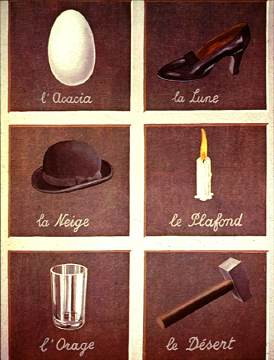
My second examples is also by Rene Magritte called "The Interpretation of Dreams  1930 Munich Germany  Oil on canvas


We are confronted with 6 images of familiar objects together with verbal labels - (which are familiar in the language - learning context) suggested by the blackboard like background.  But we soon realise that the words do not match the images under which they appear.  If we try to rearrange them we find that the words do not correspond to any of the images.  In order to be able to operate with symbols it is necessary to 1st be able to distinguish between the sign and the object it signifies  (Leach 1970 43).  Jerome Bruner observed that pre-school children thought and the object of thought seemed to be the same thing, but once at school they learn to separate word and thing (Bruner 1966)  The child soon discovers the apparently magical power of words for referring to things in there absence.


Personal Values   1952   Rene Magritte  1952  San Francisco U.S.A.   Oil on canvas   


In the painting Personal Values the objects of vanity suddenly take on great importance.  The painting is based on a simple but very effective visual trick, objects from daily life are blown up to a monumental scale, and then placed back into a personal setting where they completely dominate and become shocking.  Magritte presents the room with these familiar things but brings  human proportions to the props of everyday life creating a sense of disorientation and incongruity (the inside and outside are inverted) by his rendering of a sky scape on the interior walls of the room.  The familiar becomes the unfamiliar, the normal strange.  Magritte creates a paradoxical world that is in his words " defiance of common sense"


Salvador Dali   The Persistence of Memory  1931 Oil on Canvas   New York


The beach and rocky terrain shown at the top of the painting were likely influenced by Dali's childhood experiences hence the single apparently dead olive tree underlines the dreamlike and desolate character of this landscape.  (Traditionally the olive branch is a symbol of peace, purification and plenty).  The foreground represents a timeless and nameless inner space.  The watch could allude to time passing memory and decay.  The softness of the instruments for measuring time however renders them unreliable.  The limp head in the centre is thought to be Dali's own face, its shape deriving from a large standing rock near the Coast of Cadaques,  with the long eyelashes and tongue like protuberance which could heighten the erotic feel of this creature- the insects are associated with decay - together with a fly- could the meaning be an experience of seeing a dead animal being eaten.


Two examples of contemporary media - making use of Jacques Lacan's idea of Mirror Phase.    

In advertising we are invited to project ourselves in to the picture or subject thus becoming the perfect model for the subject advertised.


The film  Curse of the Cat People -This  has Amy the young daughter of Oliver and Alice Reed as a very imaginative child who has trouble differentiating fantasy from reality, has no friends of her own age so makes an imaginary friend through her father's 1st wife at the same time she befriends an ageing reclusive actress who is alienated from her own daughter.


The Per Capital Principle   poster by Morgan Slade and Alex Gross.


A film director - who directs actors and film crew alike, control artistic and dramatic aspects.

The gaze is a psychoanalytical term used by Jacques Lacon it describes the relationship of the subject with the desire to look and the awareness that one can be viewed.  The love story, Titanic (1997) a fictional account of the tragic sinking of RMS Titanic (director James Cameron), involoved a fictional love story of Jack ( who dreams of a new life in Amercia) and Rose (the daughter of a once rich family who is being forced to marry into a rich family) This is played out along side the traumatic sinking of the Titanic and the loss of so many lives.  Their love story sustains the viewers enjoyment.


Sunday, 1 April 2012

Project 17 Freud, Oedipus and castration

Project 17 Freud, Oedipus and castration

When Freud was around in the early 20th century the male was considered the number one in society, women being the weaker sex, there to do the biding of the male- thus Freud suggests that in the 1st stages of development awareness the child is attracted to the opposite sex and senses rivalry with the same sex as themselves. (he called it the Oedipus complex) he believed that this complex is a universal phenomenon, from our evolutionary make up and is responsible for our guilt complex in the matter.

The dissolution of the Oedipal Complex (Freud 1977) pinpoints which this repressive structure forms and also discusses the causes for its creation.  He (Freud) suggests that the male child wishes to replace his father in the family structure - he identifies the paternal figure as authority therefore by extension have relations with his mother, at the same time being fascinated by his penis he betrays the fact by playing with it frequently (Freud, Oedipus 316)  This met with disapproval by authoritative figures, women and men alike.
The complex itself then is how to replace either the mother or the father without the loss of the penis through castration.

Freud suggests 2 outcomes=   the child replaces the father and has intercourse with the mother or he might want to take the place of the mother and beloved by the father.  (highly unlikely!)

He, Freud theories that adult subjectivity is determined by experiences in childhood and that any experience that differs from the Freudian norm are bound to have a very important bearing on the development of the individual.

Edward Munch   Ashes    This depicts the end of a love affair with the man in despair and the woman indifferent.  The title Ashes refers to the burned out log that runs along the pictures edge  (burned out love) or the death of love.

Munch Norwegian B.1863 D.1944 was tortured by sickness ,death, insanity, rejection, unhappy love affairs and guilt (a text book case for Freud).


In Ashes the feelings of death and despair are shown the work illustrates at least 3 examples of head trauma imprint and the need to support the battered head.  The less obvious being the rock pressing the top of the scull in the right lower corner of the painting.  Other rocks that symbolise skulls of death can be seen just behind the waist of the woman.  The tree- the forest is dark and frighting the decaying tree on the left and the bottom are both symbolic of death.  The body remembers early trauma and the hands would try and attempt to comfort the area that had been effected by the traumatic trauma although the person would not be aware of the previous trauma.  The woman holds her head in sorrow.


A quote from Munch -" for as long as I can remember I have suffered from a deep feeling of anxiety which I have tried to express in my art without anxiety and illness I should been like a ship without a rudder".


Castration in seaside postcards  (humorous variety)

(Small history of the saucy seaside postcard:-  they became wide spread in the 1930s at the peak of their popularity the sale of these reached a massive 16 million a year. They were often bawdy in nature making use of innuendo and double ententes and traditionally featured stereotypically characters such as vicars, large ladies and small put upon men mostly husbands!  Donald McGill was well known as the king of saucy seaside postcards he designed and produced over 12,000 seaside themed cards between 1904-1962.  This then moved forward in the film and television industry with the likes of the Carry on films,  Benny Hill, George and Mildred  etc.


In this postcard the speech in the bubble reinforces the image of the man being the submissive partner  in the relationship who has to seek the advise of his wife on the possibility of help from a doctor concerning his lack of sexual desire - which also reinforces the relationship by showing the domination of the woman (who humiliates him by the response that he is beyond help).  This size relationship can be revised in the same card by the man being  muscular and overpowering against the petite female ( the artist is then turning the cultural relationship of men and woman on his head!!  Only exaggerating the difference would the possibility of such behaviour as depicted on the postcard drawing would be acceptable.


On the postcard above  although the woman is large she has a number of children around her together with the newspaper head line and the (Lumme! - I must warn Bert!) suggests that as mentioned above the man is the dormant partner in this relationship. ( Or is he)!!


We now move to the cinema posters with the provocative female (the high heeled shoes, black stocking,suspenders, open top nurses uniform, long blonde hair, long legs sitting on a stool holding a newspaper with a suggestive headline.  The background comprises of a Large letter X with more suggestive pictures behind.  The colours of blue, black and white are bought forward in to the main theme of the girl the stool the blue under her foot and the orange at the bottom of the poster.  This could be construed as a open invitation.

Project 16 deconstruction- terms of Art


Project 16 deconstruction - terms of Art

The philosopher Derrida divided his time between France and California (University of Irvine). He was given the credit (by some) as the founder of deconstruction (the process of taking concepts apart and rejoining then again sideways or inside out etc.).  He was made aware of this as he move back and forth between France and the U.S.A. Sometimes they (deconstructionists) insist that there is no grounded perspectives (that all are complete) and that we cannot afford to choose one from another this leads to the concept of pluralism(has more than one ultimate principle) and postmodernism (specifically a reaction against modernism said to begin with pop art) Many see these arguments as important to getting to see all perspectives.  While other choose to  avoid this.  At some point there is no grounded perspective that all are complete and that we can ill afford to choose one over the other - Thus the concept of pluralism and post modernism.

Project 16 deconstruction - terms of art

Project 16 deconstruction - terms of art

Examples of deconstruction of an image in film

CBS mini series The Regan's was presented as a deconstruction of the Regan adminisation.

The film Shriek can be considered as a deconstruction of a popular fairy tale.  The terms also used to describe older parades such as Don Quixote and Gulliver's Travels.  Which deconstruct the concepts of knightly order and genre of travel goers respectively.  Thus the use of this term which is only slightly connected to Derrida's original seems to take hold in various ways in recent years.

Gillian Dyer claims that advertising is "the official art" of the advanced industrial nations of the west (1982)

Some even suggest that this works in the same way as myths and primitive societies in as far as it conveys values and beliefs through providing the onlooker with simple stories and explanations which help them to organise their thought and experiences and to make sense of the world.

Every day we are surrounded be advertisements which ever way we turn we will see some form of publicity (latest offers at supermarkets- billboard- magazine's- newspapers- adverts of television even when going to the cinema).  Yet very often we are not aware of the impact these have on ourselves.  Advertisers try to manipulate society into buying a new way of life.

Thursday, 12 January 2012

Project 15 Author? what Author?


Project 15 Author? what Author?

Section 1   Michel Foucault      What is an author   pps 949-953

At the start of this essay Foucault is being provocative taking a given and turning it into a problem at 1st glance his question (what is an author) seems pointless as we have become accustomed  to the way we think about authors and authorship.

Foucault reminds us that we regard the concept of authorship as "solid and fundamental" the concept has not always existed. It "came to being at a particular moment in history and it could pass out of being in the future".

He also seems to take up or have a  habit of thinking about authors as individuals, heroic figures who can transcend or step outside history.  Why should we think this way, why not consider the notion that authors are products of our time?  According to Foucault, Barthes had encouraged other critics to realise that they could "do without (the authors) and study work itself   (Question  how can you if you have nothing to go on in the 1st place)?

Foucault then turns his attention to a rival (Derrida though he does not mention him by name) and claims that although Derrida like Barthes presents his views as radical they are quite conventional.  Foucault suggests that Derrida recognises the author, but instead reassigns the author privileges and power to writing or language itself. Why does he bother to do this because he enjoys a fight and does not want his readers to assume that being an author is a dead issue a problem that Barthes and Derrida have already solved  He wishes to show that despite all their inflated language neither Barthes or Derrida has broken away from the question or the author----much less solved it.  Foucault then asks us to think about the ways in which the name functions in our society - names of authors often serve a classificatory function.  For example if you were to go to a bookshop or library and were looking for a certain book you would look for the authors name not the title, what it is about, what year was it  written or published.  You would look for the author.  Why do we assume that it is natural to look this way? What if we were to discover that it had not been written by this person would we be disappointed, after all the novel etc would not change.  Foucault goes on to introduce his concept of the "author function" this is not a person and not confused with the author or the writer it is more like a set of beliefs or assumptions that govern the production, circulation, classification and reading of the text.


Section 2    Roland Barthes  essay  The death of the author  pps 142-148

Barthes opens with a quote from Balzac's novel Sarrasine where the author offers a description of a "castrato" disguised as a woman (p.142)   "this is a woman herself, with her sudden fears, her irrational whims, her instinctive worries, her impetuous boldness, her fussing and her delicious sensibility" (p142)  One of the most widely-known features of intertextuality is Barthes claim that of the death of the author.  He combines psychoanalytical and linguistic theories to argue that the orgins of the text is not a unified authorial consciousness but a plurality of other words utterances and other tests.

Barthes suggests that the meaning of the authors words does not originate from the authors own unique consciousness but from the place of words within linguistic and cultural systems.  The author has the role as a compiler or arranger of pre-existent possibilities within the language system.  Each word sentence, paragraph etc.that the author produces takes its origins from the language system out of which it has been produced.  This view of language expressed by Barthes is what theorists termed inter textual (to Barthes this means that nothing exists outside the text) he destroys the idea that meanings come from and is the property of the individual author.  This synthesises the view that by saying that " the modern sciptor, when they write is always already in the process of reading and re-writing  meaning comes not from the author but the language viewed.  The nature of writing turns both the traditional author and critic in to readers.

Bathes concludes `The Death of the Author` with the following --- a text is made from multiple writings taken from many cultures and entering into mutual relations of dialogue, parody, contention but there is one place where this is focused, that of the reader not as hitherto said the author.  The reader is the space on which all the quotes that make up the writing are inscribed without any being lost a text lies not in its origins (writer) but in its reader so the birth of the reader is the death of the author.

Question  In their view does this mean in the context of art the painter is not the author but the viewer is?  So when we study a painting we interpreted it as our authorship?

Michel Foucault's

At the start of this essay Foucault is being provocative taking a given and turning it into a problem at 1st glance his question (What is an Author?) seems pointless as we are accustomed we have  become to thinking about authors and authorship.  In this section Foucault reminds us that we regard the concept of authorship as "solid and fundamental" the concept has not always existed.  It "came into being at a particulure moment in history and could pass out of being in  the furture.

Foucault also seems to take up our habit of thinking about authors as individuals heroic figures who can transcend or step outside history.  Why should we think this way,  why not consider the  notion that authors are product of their times?

According to Foucault, Barthes has encourged other critics to realize that they could "do without (the authors) and study the work itself.)  Question  how can you if you have nothing to go on in the 1st place?

Foucault then turns his attention to a rival (Derrida though he does not mnetion him by name) and cliams that although Derrida like (Barthes) presents his views as radical they are quite conventional.  Foucault suggest that Derrida reconnises the author, but instead reassigns the authors privileges and power to writting or lauguage itself.  Why does he bother to do this, because he enjoys a fight and does not want his readers to assume that being an author is a dead issue a problem that Barthes and Derrida have already solved.

He wishes to show that dispite all their inflated language neither Barthes or Derrida has broken away from the question of the author --- much less solved it.

Foucault then ask us to think about the ways in which the authors names functions in our society - names of authors often  serve as a classifactory function. i.e.  if you go to a book shop or libuary and are looking for a certain book you would look for the authors name not the name of the book or want it is about (accept for looking under the heading of study, general reading or reference etc) or what year it was published or writtn.  Why do we assume that it is natural to look this way,  what if we were to discover that it had not been written by this person, would we be dissapointed after all the novel etc. would not change.  Foucault goes on to introduce his concept of the authors function  this is not a person and not confused with the author or writer it is more like a set of beliefs or assumptions that goven the production circulation, classification and reading of the text.

I think the art work of both Sherrie Levine and Cindy Sherman is explained in the articles by Foucault and Barthes.  Their work is a mixture of signs which can be liked or dislikes by the viewer (as with other artwork in depends on the person viewing the subject) One example of this is Sherrie Levine's re-photograph  of Walker Evans 1936 photos of a family of sharecroppers in the depression each one using slightly diffrent images so the question one askes is the author Walker or Lervine. At first glance I would say Walker as he did the the orginal then Levine alters the look and gives it a diffrent intrepretation thus giving a diffrent prespective so she could be the author of her photograph?

Cindy Sherman on the other hand does not directly make reference to the orginal work of others.  The author became the actress taking on the role.  Sherman allows the reader to resonate they own meaning from the image.

The cultural move following the 2 articles with the birth of the reader at the expense of the author makes Benjamins concept of the aura in artwork as not so relevant.


Friday, 30 December 2011

Project 14 Myth is a type of speech

Project 14  Myth is a type of speech


In Myth to-day Barthes claims with a witty saussurean irony that this Lolita this poetess named Minou Drouet had her own system of signs (Barthes explains with a clinical disinterest of a scholar who likes boys not girls).  "A tree is a tree. But a tree expressed by Minou is no longer quite a tree it is decorated, adapted to a certain type of consumption laden with literary self-indulgence, revolt, images in short a type of social usage which is added to pure matter".  Barthes is out to destroy the "myth of childhood as a poet".

(Minou Drouet was a poet, musician and actress- a talented young lady Barthes used her in his text to show how myth is used in literature and can distort the signifier signified and therefore the sign)

Therefore take language, discourse speech etc to mean any significant unit or synthesis either verbal or visual, a photograph will be a kind of speech for us the same as a newspaper article even objects will become speech if they mean something long before the invention of the alphabet, objects or simple drawing etc. have been accepted as speech (telling a story, an event in history, how people lived and survived).

Myth today is a type of speech not any type language needs special conditions in order to become a myth

Dictionary definition :  Myth is a fable or narrative under which is hidden a historical or mural truth an invented story (The Westminster English Dictionary) It is therefore not confined to oral speech it can consist of modes of writing or of representations not only of writing but also photography, cinema, reporting, paintings, sport, shows etc.  all these can serve as support to mythical speech.

With regard to the"bunch of roses and a black pebble, roses particularly red roses are passion and love while black pebbles bring to mind coldest and hard these convey emotions  Another example is fire - hell different colours associated with heat, anger and hatred.  The shape of the heart  in any form other than medical represents emotions or love so is not the real representation of an organ.  It is another myth that we have created to signify where we associate where our feelings come from.  (not in the mind?).

James Ravilious 1939-1999  Photographs in black/white are so profound images of all aspects of local life (Devon) landscape, farming life in local towns and villages and their special occasions each one tells a story.


Ivor Brooks rescuing  a lamb in blizzard Miltham Dolton Devon 1978


Archie Parkhouse and Ivor Brooks moving a sick lamb  (in an old tin bath)  Dolton Devon 1976


The Mad Hatter Tea party  By Arthur Rackham  1867-1939


This picture comes from the  classic book Alice in Wonderland (a young girls search for the meaning of a confusing world strikes a chord in a peculiar tale of logic and fantasy).  It is considered to be one of he best examples of literary nonsense genre and its narrative course and structure have been enormously influential especially in the fantasy genre.

Alice is a guest at a " Mad Tea Party"  with March Hare, Mad Hatter and a Sleeping Dormouse" who remains asleep in the teapot of most of the time.

The Hatter is most likely to be a reference to Theophilus a furniture dealer know for his unorthodox inventions.

The March Hare, the Hatter and the Dormouse give several examples in which the semantic value of a sentence (A is not the same value of the converse of A)  i.e. "why you might just as well say that ` I see what I eat' is the same as `I eat what I see"  in logic this is discussing an inverse relationship.

Alice also ponders that meaning when changing chairs around a circular table then places them back where they started.  This is an observation of additions on the ring of ` integer's modulo'